Good ol' Schmality. He was my lab partner in Orgo sophomore year. That guy could rotovap like nothing I have ever seen previously or since.
These new changes to the league are horrible! I mean, adding Chandler? Who is this guy? A decorative hanging light with branches for several light bulbs or candles? A female comedianne who has a new NBC sitcom whose title replaced the word "Vodka" with her first name? A town in Upper Hominy, NC? What's that off-screen voice? Oh, you said Chandler. I misheard you. That I am cool with. Welcome Chandler! You literally only need have a pulse to be a more active participant in the league than Andrew. Will you ever read these words? I doubt it. Why would you be any different than the rest of the human population.
Of course, the above few lines are in jest, I have no life threatening problems with the rules changes. I mean, I am not a fan, but I have a feeling that is more because of Newtonian physics (inertia and whatnot) than any real problem with them. Switching from wins to quality starts will make some pitchers get better, some get worse, the very notion of fantasy sports will be further cemented as having nothing to do with real life baseball and will be more based on individual performances than actual baseball outcomes. I am less interested in how the changes will affect the league than which players will see their values modified.
I looked at last year's pitching statistics for the real life MLB league and was able to extrapolate a few key findings that may change how you perceive the very reality in which you have grown comfortable.
Not surprisingly, this rule change will most benefit starters and disfavour relievers. The pitchers who would have most profited from this rule change are Matt Cain (an Ackbar) and R.A. Dickey (Never pitched an inning for our league). Both of these "pitchers" "pitched" 14 more quality starts "than" they turned in wins. Think about that in this coming draft: Matt Cain had a 2.88 ERA and should have had a lot more wins than he did while striking out a respectable 7.26 guys per 9. Next, Brett Myers was next with 12 fewer wins than quality starts next, followed by 5 guys with 11 (notably Tim Stauffer who I picked up for 3 spot starts, all of which went horribly, and Anibal Sanchez, who still was quite the waver wire pick up for the Omars. Imagine him with an extra 11 wins and all those K's. Indeed.).
Conversely, the reliever who will most suffer from this rule change is something called a "Matt Belisle" that somehow managed to acrue 10 wins without a single quality start. After that thing, Eddie "The Mooch" Mujica had 9 wins in relief, followed by a bunch of guys with 8 wins, most notably Mark Melancon who was also able to put up 20 saves for the Dykstras. Interestingly, John Lackey and Esmil Rodgers both has 3 more wins than quality starts meaning that they got quite lackey, er, lucky. Both spent some time on teams in the league (The Peachz and the Bernies, respectively). They were both horrible, and just when you thought it couldn't get any worse, they were actually worse than their stats indicated.
Beyond individual pitchers, one of the real consequences of this rule change is that we can no longer say, "pick up all Yankees pitchers, with their offense, they will win games if their pitcher puts in a quality start." Looked at more statistically, the teams who could most be counted on for producing wins from quality starts were the Red Sox and the Yankees, producing 88.4% and 84.5% of the wins that they had quality starts. In other words, Yankee and Red Sox pitchers will be less valuable this coming season than they were last. Conversely, the Colt 45s and Marlins formerly of Florida, presently of Miami only produced 44.3% and 48.8% of the wins as they did of quality starts. Not surprisingly, these two had two of the worst bullpens in the majors producing 55 and 50 decisions (wins or losses) last season. Along with the Cardinals, Bravos, and Reds all had 50 or more decisions coming from the pen. Without all those bullpen disasters, the pitchers on these teams should see their stocks rise marginally. The Dbacks and the Dodgers had the fewest decisions coming from the pen, though the meaning of this is obscured from my too-close-together-eyes. Did you know that I can only use 2 of the 7 microscopes in my lab because these are the only two whose eye pieces come close enough together to accommodate my cyclopean mug? God, I am a hideous goblin.
Sunday, January 15, 2012
Wednesday, April 6, 2011
Draft Recap Part 3, the final part - By $alary!
In our draft for D&D Baseball: The Gathering, we picked any players regardless of how much their contracts would drive up ticket prices for our elven fans. I looked at the 2011 cost of each of the players picked in the draft to see if there was any correlation between where a player was picked and how much he made. This beautiful tricolore graph that you see below this text that you are currently reading shows how much the average, maximum, and minimum salary of a given round measures against the average, maximum, and minimum spent in the average round. In round 20, for example, the total salary was the exact same as the average salary per round of the total draft as shown by the fact that it measures a 1.0, or 100% on the graph. Below the 1.0 line means that that round had a lower average than the average round, above means a higher average than the average round. Confused yet? Too bad! That is all the explanation that will be given.
By and large, it seems like each round of the draft was fairly, well, average. In the early rounds, there was a lot of money spent (round 1 had a total of $118 million, round 2 had a total of $138 million, the average per round was $63 million), but the most expensive player in those rounds wasn't significantly more expensive than the average most expensive player per round. This becomes clear when you look at the most expensive players in each round:
Each one of these is a high priced player, some who have lived up to the contract, others who have not. Only in round 2, where ARod, the highest payed player in the history of the game, the man whose salary could have bought Bear Sterns and had money left over, was significantly over the average maximum salary per round ($31 million as opposed to the average maximum of $15.8739 million). Where the biggest difference lies is in the minimum salary per round. Only in the second round, where Nelson Cruz was the lowest paid player taken, was the lowest paid player significantly above the average lowest salary for all the rounds. Cruz's'z contract, which pays him $3.6 million this year, is quite a bit more than many of the other minimum salaries of the lowest paid players in the rounds who made the league minimum of around $450k, and more than the average minimum salary of $811,976.9833. Players who made the league minimum were taken in an overwhelming majority of the rounds, starting as early as round 3, where the Dread Pirate was taken by Omar at a full 50 times lower salary than the highest paid player in that round, CC Sabathia ($450k vs $23 million). Even in the first round, there were 5 players whose salary was $5.5 million or below (Braun, Tulo, AGon, and Votto). Conversely, even in the 23rd round, there were players who signed large contract years ago and failed to deliver (AJ Burnett at $16.5 million and Lance Berzerkman at $8 million). Indeed, there was talent to be found in all rounds of the draft no matter what the price tag.
I next wanted to look at the total payrolls of each of the teams. Tabulating the team that hit the field opening day, I found that Andrew's team was by far the most expensive team, but the rest of the teams were all pretty clustered together.
Looking at the makeup of Andrew's team reveals the reason for his free spending: the glut of Yankees on his Roster. Between ARod, Jeter, Mariano, and AJ Burnett, Andrew spent $77,5000,000, alomst 75% of Omar's complete roster and about half of the average team payroll. It was also interesting to note that, despite going quite young on his team, Lenny Dykstra didn't save much on his payroll having the 7th highest payroll in the league. Omar, coming in with the lowest payroll of $91 million, saved a lot of money by having his high round draft picks be cheap players who will soon be free of the sheckels of thier minor league long term deals. Joey Votto, David Wright, Andrew Mccutchen, and Hunter Pence were his first 4 draft picks and had a total salary of $26 million, less than twice the average salary for the 6 highest paid first rounders alone (Pujols, Hanley, Miguel Cabrera, Halladay, Holliday, and Crawford. Average salary: $16 million). Indeed, Omar sniffed out that value quite nicely.
Finally, I wanted to look at the spending habits of each team individually. I found who was the highest and lowest paid player for each round, as you saw above, and correlated that with who picked them. In other words, which teams were the most swayed by the high price of admission and which were the biggest bargain seekers.
As predicted, Andrew broke the piggy bank 7 times (ARod, Mauer, Jeter, Ethier, El Caballo, Derek Lee, and AJ Burnett) the most of any of the teams. As some may have predicted perhaps maybe, Ackbar sought value 5 times (Young, Scherzer, Daniel Hudson, Jose Tabata, and Jesus Montero) ,but was not the most value conscious drafter in the league. That honor went to Omar, who only spent the most in a round once all the way in round 21 with Big Z, but spent the least 5 times (McCutchten, Pedro Alvarez, Kershaw, Travis Snider (?) and Matt Wieters). Fooey and Bernie were the most boring spenders only going for the most expensive and least expensive players in a round once (Roy Oswalt and Travis Wood, and Carlos Beltran and Brett Anderson, respectively).
So that's it, that is how we drafted. I highly doubt that anyone made it all the way to the bottom of this post without skipping over some portions of what I have written. That's ok! I don't mind! If you read any of it, though, put a thought in the comments section! Or Email me if you want to write a post! That will be the last plea, but the offer will remain for the season. Also remember, while I wrap these numbers around myself like a warm blanket at night, you can write about individual players, as Tim previously had with Ben Zobrist, or weird lists about most upsetting injury or most soul crushing home run of the week or something! I know from seeing you (YOU!) during the season that you have a lot to say about the fantasy season and the league in general, so why not put that digital pen to paper and those grubby fingeys to keyboard and share it with the league, nay the world in total! You will feel better about yourself! And then much much worse after you hear a room full of silence.
I next wanted to look at the total payrolls of each of the teams. Tabulating the team that hit the field opening day, I found that Andrew's team was by far the most expensive team, but the rest of the teams were all pretty clustered together.
Looking at the makeup of Andrew's team reveals the reason for his free spending: the glut of Yankees on his Roster. Between ARod, Jeter, Mariano, and AJ Burnett, Andrew spent $77,5000,000, alomst 75% of Omar's complete roster and about half of the average team payroll. It was also interesting to note that, despite going quite young on his team, Lenny Dykstra didn't save much on his payroll having the 7th highest payroll in the league. Omar, coming in with the lowest payroll of $91 million, saved a lot of money by having his high round draft picks be cheap players who will soon be free of the sheckels of thier minor league long term deals. Joey Votto, David Wright, Andrew Mccutchen, and Hunter Pence were his first 4 draft picks and had a total salary of $26 million, less than twice the average salary for the 6 highest paid first rounders alone (Pujols, Hanley, Miguel Cabrera, Halladay, Holliday, and Crawford. Average salary: $16 million). Indeed, Omar sniffed out that value quite nicely.
Finally, I wanted to look at the spending habits of each team individually. I found who was the highest and lowest paid player for each round, as you saw above, and correlated that with who picked them. In other words, which teams were the most swayed by the high price of admission and which were the biggest bargain seekers.
As predicted, Andrew broke the piggy bank 7 times (ARod, Mauer, Jeter, Ethier, El Caballo, Derek Lee, and AJ Burnett) the most of any of the teams. As some may have predicted perhaps maybe, Ackbar sought value 5 times (Young, Scherzer, Daniel Hudson, Jose Tabata, and Jesus Montero) ,but was not the most value conscious drafter in the league. That honor went to Omar, who only spent the most in a round once all the way in round 21 with Big Z, but spent the least 5 times (McCutchten, Pedro Alvarez, Kershaw, Travis Snider (?) and Matt Wieters). Fooey and Bernie were the most boring spenders only going for the most expensive and least expensive players in a round once (Roy Oswalt and Travis Wood, and Carlos Beltran and Brett Anderson, respectively).
So that's it, that is how we drafted. I highly doubt that anyone made it all the way to the bottom of this post without skipping over some portions of what I have written. That's ok! I don't mind! If you read any of it, though, put a thought in the comments section! Or Email me if you want to write a post! That will be the last plea, but the offer will remain for the season. Also remember, while I wrap these numbers around myself like a warm blanket at night, you can write about individual players, as Tim previously had with Ben Zobrist, or weird lists about most upsetting injury or most soul crushing home run of the week or something! I know from seeing you (YOU!) during the season that you have a lot to say about the fantasy season and the league in general, so why not put that digital pen to paper and those grubby fingeys to keyboard and share it with the league, nay the world in total! You will feel better about yourself! And then much much worse after you hear a room full of silence.
Tuesday, April 5, 2011
Draft Recap Part 2 - By Age!
Drafting by position or via computerized spreadsheet is well and good, but sometimes, the sight of a young rookie with high upside and the potential to be kept for the next 3 season is good enough to make you throw out all plans, rankings, and vestiges of heterosexuality and take the gambol. Conversely, no matter how good an aged player performs in the previous year, there is always the thought that his broken typewriter body will eventually hit one last pot hole and the screws will come off like in Cool Runnings. To get a sense of how realistic either one of these two hypothetical situations are, I looked at the draft according to age.
The first thing that I noticed looking at this young fellow in the mirror is the even distribution of body hair throughout the torso. Then, when shifting my gaze to this young graph, I saw that the overall distribution of ages in our league seems to peak around 29 years old [a little younger than most people in this league. We are never going to play professional baseball! I cry!] with more older players being picked than younger players, as shown by the more gentle slope on the right of the peak than the left. Moreover, I saw that in the early rounds, there is a very large cluster of ~30 year olds being picked up with very few fogies or youngsters. As we went through the second and third set of set of rounds, this distribution because a bit more heavy on old fellows, but it wasnt until the 13th round where youngsters started to find their way off the board. As things wound down, a new peak at around 24 years old began to rise with people looking for their young keepers. It is interesting that there was so much more faith in the old guys (taken much earlier in the draft) than in the young guns (taken much later in the draft) when it is often the youngsters who end up being the break out stars. At least I found that interesting, and I hope that you did too, though by "you," I mean me, the only one who actually reads this idiotic blog, and I don't even read it that closely after I write it in the first place!
I next wanted to see if there were any teams that were particularly filled with old fellows or youngsters. Looking at the distribution of ages on each particular team, I was surprised to find that the teams were quite different, as you can clearly see below. See it I command!
A few things stood out about these distributions. First is the relative age of Judd and Jeter's teams. Both seemed to load up on older types at the expense of young talent. Perhaps they think they can pick it up on the wire? Who knows what thoughts run through the minds of men! Regardless, look for these teams to have a rash of injuries and resemble the beloved Ackbars, who are currently dealing with, count 'em, 6 players who are not getting into games these days. I was also mesmerized by the youth of Lenny Dykstra's and Texas the Foo's teams, whose players seem to peak at about 26 with only a few wily veterans to show the youngsters the way. Dykstra projects to do well this year, but who knows if those optomistic projections based sometimes on talent alone will translate to major league stats. Beyond that, everyone else seemed to have a bunch of 29 year olds with a few yongsters and a few more old types hanging around, with Woo Woo and Peachz (here in fashionable hot pink!) having the most clustered distributions.
How will the age of these players affect each team? Will the old guys have one more year in their arms or will they crumble like a delicious Drake's Coffee Cake? Will the young fellows be able to withstand the hot glare of the media and perform in the show or will they be more like Steve Nebraska (who actually did both, the breaking down and the performing. Remember the climax of that ludcrous movie when Brendan Frasier pitched in game 7 of the world series after never pitching before in the majors and throwing just 81 pitches, all strikes, in a complete game perfect game 27K performance.) Will these teams have the same age distributions at the end of the season? How will the free agent pickups look in terms of age? I look forward to watching it all unfold.
In other news, my inbox was flooded with people wanting to write on the blog! Hyyyche that and reverse it, no one said "boo." Seriously, if you want to write something, anything, about the league and it wont fit in the message board or you want to attach something or whatnot, shoot me an email! Or a trade offer! I guarantee to always give a counter proposal. Here is a sample topic that you could write about that builds on what you have just read: "The best picks among players over 35" or "The 5 over-35 years olds who will be better than the under-25 year olds drafted in the same round" or something like that. I can furnish you with all the data you could ever need or want, though only about fantasy baseball, sorry Justine, you need to gather that thesis data yourself.
The first thing that I noticed looking at this young fellow in the mirror is the even distribution of body hair throughout the torso. Then, when shifting my gaze to this young graph, I saw that the overall distribution of ages in our league seems to peak around 29 years old [a little younger than most people in this league. We are never going to play professional baseball! I cry!] with more older players being picked than younger players, as shown by the more gentle slope on the right of the peak than the left. Moreover, I saw that in the early rounds, there is a very large cluster of ~30 year olds being picked up with very few fogies or youngsters. As we went through the second and third set of set of rounds, this distribution because a bit more heavy on old fellows, but it wasnt until the 13th round where youngsters started to find their way off the board. As things wound down, a new peak at around 24 years old began to rise with people looking for their young keepers. It is interesting that there was so much more faith in the old guys (taken much earlier in the draft) than in the young guns (taken much later in the draft) when it is often the youngsters who end up being the break out stars. At least I found that interesting, and I hope that you did too, though by "you," I mean me, the only one who actually reads this idiotic blog, and I don't even read it that closely after I write it in the first place!
I next wanted to see if there were any teams that were particularly filled with old fellows or youngsters. Looking at the distribution of ages on each particular team, I was surprised to find that the teams were quite different, as you can clearly see below. See it I command!
A few things stood out about these distributions. First is the relative age of Judd and Jeter's teams. Both seemed to load up on older types at the expense of young talent. Perhaps they think they can pick it up on the wire? Who knows what thoughts run through the minds of men! Regardless, look for these teams to have a rash of injuries and resemble the beloved Ackbars, who are currently dealing with, count 'em, 6 players who are not getting into games these days. I was also mesmerized by the youth of Lenny Dykstra's and Texas the Foo's teams, whose players seem to peak at about 26 with only a few wily veterans to show the youngsters the way. Dykstra projects to do well this year, but who knows if those optomistic projections based sometimes on talent alone will translate to major league stats. Beyond that, everyone else seemed to have a bunch of 29 year olds with a few yongsters and a few more old types hanging around, with Woo Woo and Peachz (here in fashionable hot pink!) having the most clustered distributions.
How will the age of these players affect each team? Will the old guys have one more year in their arms or will they crumble like a delicious Drake's Coffee Cake? Will the young fellows be able to withstand the hot glare of the media and perform in the show or will they be more like Steve Nebraska (who actually did both, the breaking down and the performing. Remember the climax of that ludcrous movie when Brendan Frasier pitched in game 7 of the world series after never pitching before in the majors and throwing just 81 pitches, all strikes, in a complete game perfect game 27K performance.) Will these teams have the same age distributions at the end of the season? How will the free agent pickups look in terms of age? I look forward to watching it all unfold.
In other news, my inbox was flooded with people wanting to write on the blog! Hyyyche that and reverse it, no one said "boo." Seriously, if you want to write something, anything, about the league and it wont fit in the message board or you want to attach something or whatnot, shoot me an email! Or a trade offer! I guarantee to always give a counter proposal. Here is a sample topic that you could write about that builds on what you have just read: "The best picks among players over 35" or "The 5 over-35 years olds who will be better than the under-25 year olds drafted in the same round" or something like that. I can furnish you with all the data you could ever need or want, though only about fantasy baseball, sorry Justine, you need to gather that thesis data yourself.
Monday, April 4, 2011
Draft Recap Part 1 - By Position
To more closely examine the fallout from the draft, I decided to first look at how each position was drafted. I began by looking at the percentage of total draft picks for each bundle of rounds that went to each position.
Conclusions: The first 4 rounds were dominated by corner infielders and outfielders, positions where there is pop to be had and high averages abound. The 5th-8th rounds were dominated by starters with people loading up on their aces and number 2 arms. By the 13th round, relievers were finally going off the board in significant number, and at the end of the draft, people were taking fliers on starters and outfielders.
I also looked at what percentage of each position when in each round, a similar stat to that graph you see up there above.
Conclusions: The first 4 rounds were dominated by corner infielders and outfielders, positions where there is pop to be had and high averages abound. The 5th-8th rounds were dominated by starters with people loading up on their aces and number 2 arms. By the 13th round, relievers were finally going off the board in significant number, and at the end of the draft, people were taking fliers on starters and outfielders.
I also looked at what percentage of each position when in each round, a similar stat to that graph you see up there above.
Three things stand out in this view: first, catchers were feast or famine. If you didnt get one of the really good catchers (Posey, McCann, Mauer) in the first few rounds, you waited until the end of the draft to pick up anyone left. Second, no matter how good a reliever was, they werent going anywhere near the top of the draft, and once they started to come off the board, they all came off at the same time. With reliever, who knows what is what. Is Brandon Lyon really significantly better or worse than Chris Perez? Or Jose Valverde? Or any of these other losers who will most blow up your weekly ERA and WHIP by giving up 94 runs without recording an out at some point in the season, but will otherwise be reliably boring. For the most part, at the draft, one reliever is as good as the next. Finally, I was interested in the fall off of the middle and corner infield spots. For the corner, after people got their big hitting first baseman in the first few round, they werent so much interested in the corner with the percentage of those positions dropping precipitously for the rest of the draft. Similarly, once people got their middle infielder in the 5th-8th rounds, they stayed well away from those positions. It would seem that people are getting their utility by and large from the outfield spot which rose and fell, but was pretty even throughout the draft.
What was your draft strategy? Did you want to strategically take positions or just take the best player available and then fill in the rest of the roster as the draft went on making the best of the situation? Share it in the comments!
To follow shortly...............Draft Recap by Age! Also, Draft Recap by Salary with some subtle antisemistism! Graphs! Yeah!
Also, does anyone else want to write a post or two? Seek the acclaim of your league-mates, but receive only an empty comments zone! If you don't have ideas of your own, I can even furnish you with beautiful data! Email me!
Monday, March 28, 2011
Projections!
There was a time, once, when I looked at math as the enemy. I was in middle school, then, and I tried to be cool by disregarding all academics. The conic sections, though, kept whispering in my large ears promising order and reason like a siren from that classic epic story, Saving Silverman. "No!" I shouted like Mel Gibson, "I need a woman!" Math was relegated to the prefabricated shed of my mind and trotted out only to more easily calculate the time that it would take to replenish my supply of seminal fluid. Time passed, though, and I came to terms with my geekiness, and then it actually became cool to be smart in college. I now wield the sword of math, brandish the shield of statistics, and tap two forrests of Excel in all of my ventures from the quick calculation of tips perhaps to the fantasy that is, well, fantasy baseball.
Here are the projections for our league (with all transactions up to 3/28/11 taken into effect) this year. Rather than a simple roto calculation as was given to us during the draft, this calculation is a week-to-week H2H projection system based on a number of assumptions that you will probably argue with and then present no other way of calculation:
- All starters get 1 start per week
- All relievers get equal save chances each week (not equal to each other, but equal between weeks), those being the total number of games they are projected to appear in divided by 26 weeks. This averages out to a little more than 2 innings per week.
- All players will put up their calculated at bat average (calculated by their total projections over their projected at bats) every day of the week. In other words, no injuries. Enjoy Timmyboz.
- Each week is the same, there are no ups and downs.
These numbers represent the number of times that you will win a category against another team. So if you see a 6 below HRs, it means that you are projected to win the HR category in 6 of your 9 matchups.
Leading to the overall projections:
Here are the projections for our league (with all transactions up to 3/28/11 taken into effect) this year. Rather than a simple roto calculation as was given to us during the draft, this calculation is a week-to-week H2H projection system based on a number of assumptions that you will probably argue with and then present no other way of calculation:
- All starters get 1 start per week
- All relievers get equal save chances each week (not equal to each other, but equal between weeks), those being the total number of games they are projected to appear in divided by 26 weeks. This averages out to a little more than 2 innings per week.
- All players will put up their calculated at bat average (calculated by their total projections over their projected at bats) every day of the week. In other words, no injuries. Enjoy Timmyboz.
- Each week is the same, there are no ups and downs.
These numbers represent the number of times that you will win a category against another team. So if you see a 6 below HRs, it means that you are projected to win the HR category in 6 of your 9 matchups.
Leading to the overall projections:
Thursday, March 24, 2011
A Case Study in Value: Ben Zobrist
| Oh, hey there Ben. You look nice. I'll bet you are married to a Christian pop star. |
| Jose Bautista: Batting .350 when it comes to his fantasy. |
| Player | Runs | Home Runs | RBI | SB | BA | OPS | AB |
| A | 48 | 8 | 41 | 17 | 0.243 | 0.694 | 350 |
| B | 100 | 15 | 66 | 5 | 0.307 | 0.809 | 599 |
| C | 77 | 10 | 75 | 24 | 0.238 | 0.699 | 541 |
| D | 112 | 29 | 83 | 11 | 0.269 | 0.830 | 651 |
The lines that stick out in a positive way are B and C. They are players that among the league leaders in Runs and have strong numbers in other areas. B is Martin Prado and D is Rickie Weeks, both 2B-eligible. A is Jimmy Rollins and despite the reduced ABs and high steals, there is a lot of risk here. Sure, if he hits 13 HRs and steals 30 bases, he is valuable, but his downward trends and increasing injury problems are just not for me.
C is our boy, Ben Zobrist.
His numbers compare most favorably to Rollins here, though I doubt Rollins bats .238 over 500+ ABs. 70/10/70? If you are willing to forgo a few steals, there are plenty of second basemen who will give comparable numbers ten rounds later. On the other side of this argument, in 2009 Zobrist hit 27 long balls, went 90/90, stole 17 bases, and hit a hair below .300. These numbers would make him - as he was drafted last year - a fourth round pick, no question. In fact, those numbers are better than several OFs that I would always (and did) take higher than Zobrist. (See: Pence, Hunter) Curiouser and curiouser.
| Does anyone here know about Ben Zobrist's fantasy value? |
And yet, there is one more ripple when it comes to the value of Ben Zobrist: He is RF-eligible. Now, any respectable owner is saying, "But come on, why would I play him in an OF spot?" To that I say, "I agree." Well, I used to agree. Sure, if you are someone who sees the importance of leaving the draft with some strong middle infield picks but have none through round five, go for it, take Zobrist at 58. It is a bold pick, but not totally insane. After all, the reason we play is to say 'I told you so,' and Jimmy Rollins just isn't the savvy pick that Zobrist might be. Still, even sticking to simple numbers and value, there is reason to believe that this pick - Ben Zobrist at 58 as a starting 2B - is a risk that can help win a championship. But wait! Check this out: The Ben Zobrist owner, beyond conventional wisdom, IS penciling him in as an outfielder, instead filling his MI spots with Troy Tulowitzki, Ian Kinsler, and Rafael Furcal.
The water grows murkier. Value is confusing.
What will 2011 hold for Ben Zobrist owners? Come on, nobody really knows and that is the fun of the whole thing, but after all of my number crunching, statistical remodeling, and efforts to crack the value code, this draft strategy has opened my eyes. If Ben Zobrist is taken 58th overall in order to fill your 2B or 2B/SS spot, I see little reason to get excited. However, by owning four MI players and having a strong backup for an oft-injured Kinsler or Furcal, this owner has covered some of the risks of his players and strategy, all while depleting the 2B/SS pool, which was thin to begin with. This is a strategy that I admittedly do not have numbers to justify, nor do I have the stomach to attempt, but it is a crafty manipulation of the markets on positions and a unique demonstration of a fantasy owner's desire to produce numbers from every position.
Ben Zobrist, I am watching you...
...and your Christian pop-star wife:
Thursday, September 23, 2010
Draftees Remaining in Country
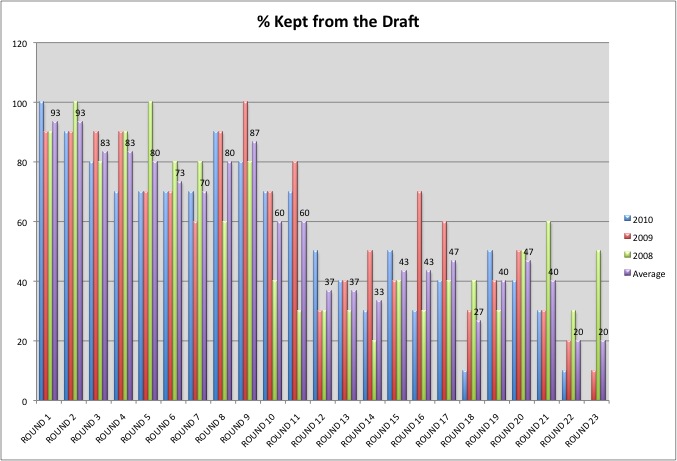
After round 11, you are more likely to drop a player that you draft than you are to keep him. Let's think about that for a second; there is a better chance that you will be wrong about how you rank more than half the players you draft. You have chosen a full dozen players before a player who will actually be valuable to you. That argument was incredibly flawed, but at least it wasn't a haiku, am I right here? Hey Now!
Also, note how, despite many players being dropped from the team to which they were drafted, a whole bunch of those were picked up and, at the end of the dayaloon, only about 32% of the rosters were populated by undrafted free agents. In other words, other people's garbage remains more appealing than plain old garbage. If it is good enough for someone else, it is good enough for me, as I always say. Also, I am not averse to eating garbage, as I also say, though less frequently.
| FA | Drafted Elsewhere | Drafted | ||
| Picture me Rollins | 4 | 6 | 14 | 24 |
| Omar's Coming | 8 | 6 | 10 | 24 |
| The Super Upton Brothers | 6 | 6 | 12 | 24 |
| It's a Trap! | 7 | 4 | 13 | 24 |
| Total Lack of Morales | 8 | 3 | 13 | 24 |
| Vaya Con Bernabe | 9 | 4 | 11 | 24 |
| Texas Fooey | 10 | 4 | 10 | 24 |
| Rockford Peachz | 7 | 5 | 12 | 24 |
| Ronnie Woo Woo | 10 | 2 | 12 | 24 |
| Omar's Spent | 8 | 0 | 16 | 24 |
Subscribe to:
Posts (Atom)